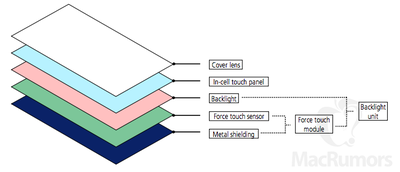
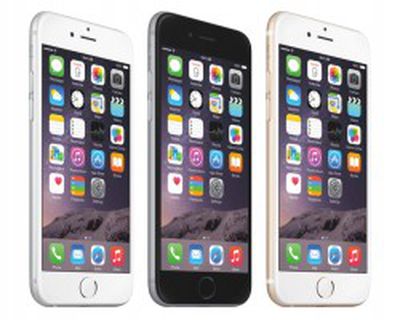
KGI Securities analyst Ming-Chi Kuo, who has a respectable track record at reporting on Apple's upcoming plans, issued a note to investors on Thursday that claims the next-generation iPhone will have a FPC-made capacitive Force Touch sensor under the backlight, laminated with metal shielding. Kuo adds that the change may be significant enough for Apple to call its next iPhone the "iPhone 7" instead of the so-called "iPhone 6s."
The analyst claims that the hardware design of Force Touch will be different than the technology used in the Apple Watch and 12-inch Retina MacBook. Instead of directly detecting the pressure applied by fingers, the new improved Force Touch hardware will monitor the contact area where a finger presses to determine how much pressure is being applied. The sensor will use capacitive technology and thin FPC material to save space.
"We believe that iPhone’s Force Touch sensor doesn’t directly detect the pressure applied by fingers. Instead, it monitors the contact area on which the finger touches the screen to decide how big the pressure is.
There are two possible structural designs for Force Touch from a technology viewpoint. The Force Touch sensor can either be placed between the cover lens and the In-cell touch panel or under the In-cell touch panel’s backlight. In the first position, the technological challenge lies with how to produce the transparent Force Touch sensor; in the second position, the challenge is how to reduce signal interference from in-cell touch panel. Our understanding of the technology is that producing a transparent Force Touch sensor is more difficult, so the chances are the new iPhone this year will opt for the second position."
Kuo adds that Apple is likely to change the hardware design of Force Touch again in 2016 by removing the metal shielding to achieve a thinner form factor. He notes that the changes should improve the iPhone user experience, but will likely create uncertainty for Force Touch module suppliers TPK and GIS, as well as metal shielding suppliers Minebea, Hi-P and Jabil.
Kuo claims that Apple is still targeting 4.7-inch and 5.5-inch models for its next-generation iPhones, akin to the iPhone 6 and iPhone 6 Plus, and notes that a 4-inch model is unlikely to be released this year. KGI Securities estimates iPhone shipments will total 25 to 30 million units in the third quarter, helping drive momentum for Force Touch components within the supply chain.
Bloomberg's Mark Gurman has high expectations for Apple's first foldable iPhone.
In his Power On newsletter today, he said the foldable iPhone will be "the most significant overhaul in the iPhone's history."
"iPhone 4, iPhone 6 and iPhone X were clearly a big deal, but this is a whole new design," he said.
Like Samsung's Galaxy Z Fold 7, the foldable iPhone will reportedly open up like ...
iOS 26.5 is now available for developers, and while it doesn't include any new Siri capabilities, there are some major changes for the European Union, and smaller tweaks for features available worldwide.
Suggested Places
In the Maps app, there's a new "Suggested Places" feature that recommends locations to visit based on trending places nearby and recent searches. When Apple launches ads in ...
Apple has been celebrating its upcoming 50th anniversary by hosting surprise performances and other events around the world over the past few weeks, and now Bloomberg's Mark Gurman has revealed details about the company's grand finale.
In a social media post, Gurman said Apple's celebrations will conclude this week with a finale at its Apple Park headquarters for employees.
A special...
Apple's second-generation MacBook Neo will launch in 2027 and could feature a touchscreen, according to analyst Ming-Chi Kuo.
Apple this week announced the MacBook Neo, an all-new entry-level Apple laptop that starts at $599, with education pricing at $499. The MacBook Neo is designed to compete with lower-cost Windows laptops and Chromebooks, while expanding the Mac lineup with a...
Wednesday March 11, 2026 4:31 am PDT by Tim Hardwick
Apple's second-generation MacBook Neo may not feature a touch-capable display after all, according to industry analyst Ming-Chi Kuo.
In a report dated September 2025, Kuo accurately predicted that the MacBook Neo would enter mass production in the fourth quarter of 2025, noting that it would not feature a touchscreen. In the same report, however, the analyst said he believed Apple...
Wednesday March 11, 2026 6:08 am PDT by Tim Hardwick
Apple's pricing for the iPhone 17e and MacBook Neo strongly suggests that Apple plans to keep iPhone 18 Pro prices unchanged when the new models launch later this year, according to industry analyst Ming-Chi Kuo.
Sharing his latest thoughts on Apple's increasingly diversifying product roadmap, Kuo said on X that Apple's strategy is to use turmoil in the global memory chip market to its...
Is that possible without calibration? A small finger pushing hard would register the same area as a larger finger pressing soft. I can't imagine it working like that.
My iPhone 5 better last a long time, because its looking more and more like my last.
----------
4 inches is just too small for a smartphone. There is a reason why 4.7 and up is the standard now. Because it is more practical.
Its a matter of how you use your phone. 80 percent of my phone usage would be 1 handed, which i can't do with the 6 making it useless and impractical for me. 4 inches is the perfect size.
They really should offer a 4,4.7 and 5.5 lnch range and that would satisfy everyone.
Is that possible without calibration? A small finger pushing hard would register the same area as a larger finger pressing soft. I can't imagine it working like that.
Exactly...I don't really believe this rumor because then even the original iPhone could have "Force Touch" - the capacitive screen already detects the entire contact area and the OS decides the center point to tell the app.
4 inches is just too small for a smartphone. There is a reason why 4.7 and up is the standard now. Because it is more practical. I don't think Apple is going back to 4 inches. With the iPhone 6 and 6+ success, there is no going back to smaller phones.


 KGI Securities analyst Ming-Chi Kuo, who has a respectable track record at reporting on Apple's upcoming plans, issued a note to investors on Thursday that claims the next-generation iPhone will have a FPC-made capacitive Force Touch sensor under the backlight, laminated with metal shielding. Kuo adds that the change may be significant enough for Apple to call its next iPhone the "iPhone 7" instead of the so-called "iPhone 6s."