Sonos Complains About Apple's Restrictions on Third-Party Siri Access in Antitrust Hearing

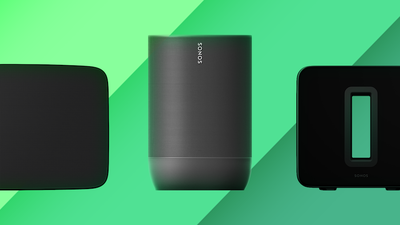
Sonos is today participating in an antitrust hearing on the smart home, where Sonos legal chief Eddie Lazarus had some commentary to share on the smart home market and the dominance of companies like Amazon, Google, and Apple.
Sonos Feature
Headed up by Amy Klobuchar, the Subcommittee on Competition Policy, Antitrust, and Consumer Rights is today hosting a hearing on "Protecting Competition and Innovation in Home Technologies." Most of Sonos' complaints relayed by Lazarus are focused on Amazon and Google, but he did have a few comments about Apple.

In particular, Sonos has taken issue with the way that Apple is implementing Siri support for third-party companies. Apple at WWDC announced that third-party companies are able to integrate ‌Siri‌ voice control into their HomeKit devices, but "Hey ‌Siri‌" commands are relayed through a HomePod or HomePod mini, making an Apple device a requirement.

Take Apple's announcement that it will now license Siri to third parties in the smart home. As reported in The Verge, Apple will only license Siri to companies that utilize the HomePod as a central hub to connect with Siri Thus, Apple is conditioning interoperability with Siri on companies placing a competitive Apple product alongside their own.

Lazarus also said that while Google, Apple, and other companies are working on interoperability through initiatives like Matter, he's skeptical that this will lead to consumer choice or foster genuine interoperability between different smart home platforms. He also warns that because Apple and Google control the standard, they have control over the "pace of innovation."

No doubt the dominant companies will suggest that new legislation is unnecessary in light of the initiatives they have underway -- like the "Matter" alliance -- that are working towards a degree of smart home standardization to facilitate interoperability. It may well be that these efforts will yield some positive results for the makers of back-end devices, such as light bulbs, garage door openers, and the like by enabling them to interoperate with any of the three major ecosystems (Alexa, Assistant, Siri) using a uniform code base. But count me a skeptic that these types of initiatives will foster consumer choice at the front-end -- where consumers control their smart home devices -- or do much, if anything, to foster genuine interoperability across the siloed ecosystems of gatekeepers. From the user's perspective, the choices among a very few walled gardens will likely remain the same. One could imagine, furthermore, a Trojan Horse aspect to all this. Those who control the standard and its evolution effectively control the nature and pace of innovation, including the innovations dreamed up by their competitors. The standard Matter is working on, as I understand it, is basically a creature of Google and Apple code. That is hardly a formula for fair competition or more creative invention. It's a formula for further entrenching the dominance of the very few.

Because Amazon and Google dominate the smart speaker market, most of what Lazarus had to say focused on those two companies. He complained that as a condition of allowing Google Assistant on Sonos speakers, Sonos had to agree to allow just one voice assistant at a time, even though it supports multiple.

But Google demanded as a condition of having Google Assistant in our products that we never allow concurrency with another general voice assistant. As a result, today Sonos customers must open an application and manually choose which single voice assistant will be configured on their device. This forced choice degrades the consumer experience, but it is arguably good for Google, which is betting that most users will choose Google Assistant as the default voice assistant and then stick to the Google ecosystem.

He said that Google and Amazon have a history of taking on competitors by producing copycat products sold at subsidized prices, which is something that Sonos and other smart speaker companies aren't able to compete with.

Amazon and Google have now come to control roughly 85% of the U.S. smart speaker market. This is terrible for innovative dynamics because it hamstrings those companies that have better products that cannot be sold at a loss and consumers lose. In addition to protecting the future profits of their dominant products and services, cross-subsidization ultimately will result in the same anticompetitive effects as "traditional" below-cost predatory pricing; prices are sure to go up once these dominant companies have driven the other companies out of the market and reduced competition.

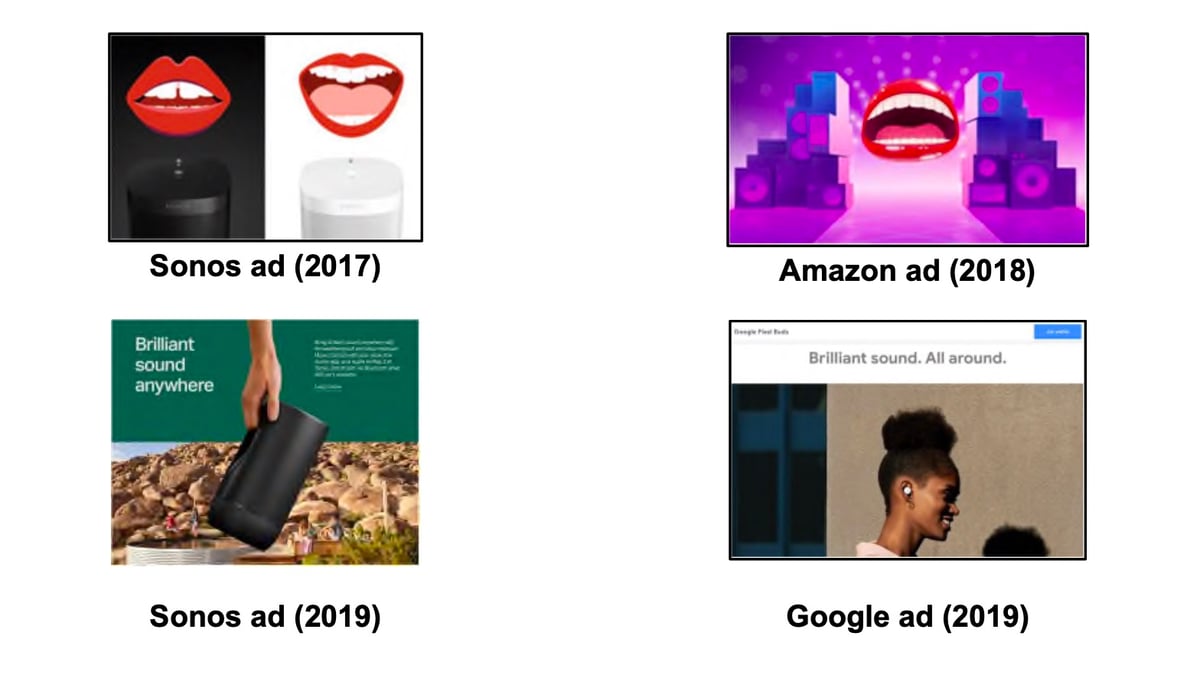
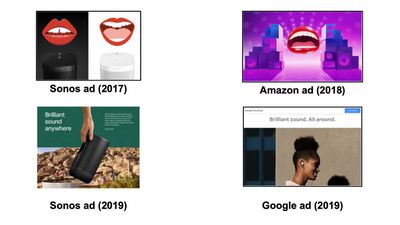
Google and Amazon have also allegedly copied Sonos advertising initiatives to confuse consumers.
sonos ad copying
If things don't change, Lazarus warns that in the future, every smart home will be controlled by a few dominant companies.

We see two possible futures for the smart home. In the first scenario -- resulting from the current trajectory we're on -- every smart home will be controlled by one of a few dominant companies, Google, Amazon, or perhaps Apple or Facebook will squeeze in too. These behemoths will exert overwhelming control over the direction of innovation and what new ideas make it to market, ultimately replicating a market structure that history tells us inhibits innovation and competition. Consumer choice will also wither. Consumers will find themselves channeled into the siloed ecosystems of a Google or an Amazon in a self-reinforcing dynamic of network fueled dominance.

With revamped antitrust law and enforcement level, the U.S. government could "broaden the playing field," according to Lazarus, allowing Sonos and other companies to "innovate and bring novel experiences to customers," with multiple companies competing based on product and services merit.

Popular Stories

Apple Wallet ID Illinois

Apple Plans to Expand iPhone Driver's Licenses to These 7 U.S. States

Wednesday December 24, 2025 8:40 am PST by
In select U.S. states, residents can add their driver's license or state ID to the Apple Wallet app on the iPhone and Apple Watch, and then use it to display proof of identity or age at select airports and businesses, and in select apps. The feature is currently available in 13 U.S. states and Puerto Rico, and it is expected to launch in at least seven more in the future. To set up the...
iPhone Top Left Hole Punch Face ID Feature Purple

iPhone 18 Pro Launching Next Year With These 12 New Features

Tuesday December 23, 2025 8:36 am PST by
While the iPhone 18 Pro and iPhone 18 Pro Max are not expected to launch for another nine months, there are already plenty of rumors about the devices. Below, we have recapped 12 features rumored for the iPhone 18 Pro models. The same overall design is expected, with 6.3-inch and 6.9-inch display sizes, and a "plateau" housing three rear cameras Under-screen Face ID Front camera in...
maxresdefault

Where's the New Apple TV?

Monday December 22, 2025 11:30 am PST by
Apple hasn't updated the Apple TV 4K since 2022, and 2025 was supposed to be the year that we got a refresh. There were rumors suggesting Apple would release the new Apple TV before the end of 2025, but it looks like that's not going to happen now. Subscribe to the MacRumors YouTube channel for more videos. Bloomberg's Mark Gurman said several times across 2024 and 2025 that Apple would...
maxresdefault

10 Mac Apps Worth Trying in 2026

Wednesday December 24, 2025 9:27 am PST by
2026 is almost upon us, and a new year is a good time to try out some new apps. We've rounded up 10 excellent Mac apps that are worth checking out. Subscribe to the MacRumors YouTube channel for more videos. Alt-Tab (Free) - Alt-Tab brings a Windows-style alt + tab thumbnail preview option to the Mac. You can see a full window preview of open apps and app windows. One Thing (Free) -...
iOS 26

iOS 26.2 Adds These 8 New Features to Your iPhone

Monday December 22, 2025 8:47 am PST by
Earlier this month, Apple released iOS 26.2, following more than a month of beta testing. It is a big update, with many new features and changes for iPhones. iOS 26.2 adds a Liquid Glass slider for the Lock Screen's clock, offline lyrics in Apple Music, and more. Below, we have highlighted a total of eight new features. Liquid Glass Slider on Lock Screen A new slider in the Lock...
airpods color prototypes

Apple Tested AirPods in Bright Colors

Saturday December 27, 2025 6:06 am PST by
Apple reportedly tested a version of the first-generation AirPods with bright, iPhone 5c-like colored charging cases. The images, shared by the Apple leaker and prototype collector known as "Kosutami," claim to show first-generation AirPods prototypes with pink and yellow exterior casings. The interior of the charging case and the earbuds themselves remain white. They seem close to some...
iPhone Fold Vertical Feature

Why Apple's Foldable iPhone May Be Smaller Than Expected

Tuesday December 23, 2025 5:21 am PST by
Apple's first foldable iPhone, rumored for release next year, may turn out to be smaller than most people imagine, if a recent report is anything to go by. According to The Information, the outer display on the book-style device will measure just 5.3 inches – that's smaller than the 5.4-inch screen on the ‌iPhone‌ mini, a line Apple discontinued in 2022 due to poor sales. The report has led ...
iPhone SE Cosmopolitan Clean

Apple Discontinued These 25 Products This Year

Wednesday December 24, 2025 7:24 am PST by
With the end of 2025 near, the time has come to look back at the devices and accessories that Apple discontinued throughout the year. Most of the products that were discontinued this year were simply replaced by a new model with an updated chip. However, the iPhone SE line was entirely discontinued when the iPhone 16e launched, and the iPhone Plus line is being phased out. Below, we have...
Foldable iPhone 2023 Feature Iridescent Search

Samsung Developing 'Wide Fold' With iPhone Fold-Like Design Ahead of Apple's 2026 Launch

Tuesday December 23, 2025 11:55 am PST by
Samsung is working on a new foldable smartphone that's wider and shorter than the models that it's released before, according to Korean news site ETNews. The "Wide Fold" will compete with Apple's iPhone Fold that's set to launch in September 2026. Samsung's existing Galaxy Z Fold7 display is 6.5 inches when closed, and 8 inches when open, with a 21:9 aspect ratio when folded and a 20:18...

Top Rated Comments

genovelle Avatar
59 months ago
So everyone hates Siri but damned if they don’t want access to it.
Score: 32 Votes (Like | Disagree)
ToomeyND Avatar
59 months ago
The walled garden team is out in force today. Having more options for equipment should be a good thing for use in a smart home product. Why on earth do you all want every product to be controlled by one company? Sonos speakers are legit, they work great (with Airplay 2 and others), offers support for google home and Alexa. They are a competitor keeping your HomePods on alert to do a good job or else. Now you all want Sonos to become their own platform? Just so that you guarantee that you can't use them with your iPhone? This is the strangest take I've seen on here in a while.
Score: 18 Votes (Like | Disagree)
jmgregory1 Avatar
59 months ago
This argument that a consumer‘s experience is negatively effected by not being able to access any voice assistant they want to use on a smart speaker is just complete bs. There are examples of all sorts of products and services where your choice is what the company provides and if you want an alternative, you can use a different company’s product.

You can’t go to Burger King and demand a Big Mac…well I suppose you can do that, but you won’t get one. You can’t buy a Honda, but demand that it has a Corvette engine in it…again I suppose that you can do that, and if you have enough money actually get what you want, but the consumer choice is in being able to buy different pieces of equipment (in the case of Amazon, Google and Apple smart speakers).

The idea that the government should mandate that competing companies all make their products or services be able to work on other company’s devices is just insane. My suggestion to Sonos - focus on making the best sounding speakers so that people can enjoy music more and not worry about the smart speaker market. The timing is perfect, given Apple is once again out of the high fidelity speaker market, and it isn’t exactly a strong suit of either Google or Amazon. Not every speaker needs to be a small counter or shelf size.
Score: 17 Votes (Like | Disagree)
vipergts2207 Avatar
59 months ago
While I certainly understand some complaints on anti-competitive behavior by the tech giants, including being forced to choose a single available assistant on a smart home device, I really don't get the complaints on Matter. It's moving smart home devices toward true standardization and that is a good thing. Apple, Google, and Amazon are all members of the Wi-Fi Alliance as well, does that mean Wi-Fi is some nefarious attempt at entrenching Apple and other's market power or that innovation will slow because of the Wi-Fi Alliance's existence? Standards either exist or they don't, and they are frequently necessary, as in the case of Wi-Fi. If the powers that be behind Matter start using the standard in an anti-competitive manner then a complaint would be valid, but from where I sit, Matter appears to be an honest attempt at tying disparate smart home devices together in a way that will likely ensures interoperability, including between competitors and different ecosystems.

https://buildwithmatter.com/

I see a lot of companies participating in Matter, but notice that Sonos is not among them. Perhaps they should join the alliance for the new standard, rather than complaining about it.
Score: 16 Votes (Like | Disagree)
Cigsm Avatar
59 months ago

('https://www.macrumors.com/2021/06/15/sonos-apple-homepod-siri-antitrust-complaints/')

Sonos is today participating in an antitrust hearing ('https://www.judiciary.senate.gov/meetings/protecting-competition-and-innovation-in-home-technologies') on the smart home, where Sonos legal chief Eddie Lazarus had some commentary to share on the smart home market and the dominance of companies like Amazon, Google, and Apple.


Headed up by Amy Klobuchar, the Subcommittee on Competition Policy, Antitrust, and Consumer Rights is today hosting a hearing on "Protecting Competition and Innovation in Home Technologies." Most of Sonos' complaints relayed by Lazarus are focused on Amazon and Google, but he did have a few comments about Apple.

In particular, Sonos has taken issue with the way that Apple is implementing Siri support for third-party companies. Apple at WWDC announced ('https://www.macrumors.com/2021/06/07/apple-announces-range-of-new-home-features/') that third-party companies are able to integrate Siri voice control into their HomeKit devices, but "Hey Siri" commands are relayed through a HomePod or HomePod mini, making an Apple device a requirement.Lazarus also said that while Google, Apple, and other companies are working on interoperability through initiatives like Matter, he's skeptical that this will lead to consumer choice or foster genuine interoperability between different smart home platforms. He also warns that because Apple and Google control the standard, they have control over the "pace of innovation."Because Amazon and Google dominate the smart speaker market, most of what Lazarus had to say focused on those two companies. He complained that as a condition of allowing Google Assistant on Sonos speakers, Sonos had to agree to allow just one voice assistant at a time, even though it supports multiple.
He said that Google and Amazon have a history of taking on competitors by producing copycat products sold at subsidized prices, which is something that Sonos and other smart speaker companies aren't able to compete with.
Google and Amazon have also allegedly copied Sonos advertising initiatives to confuse consumers.


If things don't change, Lazarus warns that in the future, every smart home will be controlled by a few dominant companies.With revamped antitrust law and enforcement level, the U.S. government could "broaden the playing field," according to Lazarus, allowing Sonos and other companies to "innovate and bring novel experiences to customers," with multiple companies competing based on product and services merit.

Written Testimony of Sonos ... ('https://www.scribd.com/document/511914140/Written-Testimony-of-Sonos-CLO-Eddie-Lazarus-in-Senate-Hearing-on-Competition#from_embed') by MacRumors ('https://www.scribd.com/user/212523051/MacRumors#from_embed')


Article Link: Sonos Complains About Apple's Restrictions on Third-Party Siri Access in Antitrust Hearing ('https://www.macrumors.com/2021/06/15/sonos-apple-homepod-siri-antitrust-complaints/')
What’s preventing Sonos from creating their own Smart Home platform?
Score: 13 Votes (Like | Disagree)
boethius Avatar
59 months ago
Sonos play fair with AirPlay 2 support. Apple can’t even begin to deliver the same home audio experience that many of us enjoy. Why not fully support it?
Score: 13 Votes (Like | Disagree)