Despite pushback from Apple, the European Parliament in January voted overwhelmingly for new rules to establish a common charging standard for mobile device makers across the European Union. This article explores what form the EU laws might ultimately take and how they could affect Apple device users in Europe and elsewhere.
What Exactly is the EU Calling For?
To reduce cost, electronic waste and make consumers' lives easier, Members of the European Parliament (MEPs) want "binding measures" that ensure chargers fit all smartphones, tablets, and other portable devices.
According to a 2019 impact assessment study on common chargers of portable devices conducted by the EU, almost a fifth of people surveyed reported having faced "significant issues" because of non-standard chargers. Such issues included incompatible chargers between devices, variable charging speeds between different chargers, and having to have several chargers available to cover all needs.
In addition, the EU claims that by agreeing on a common charger standard, it will put an end to charger clutter and 51,000 tons of electronic waste annually.
The recent 582-40 parliamentary vote in favor of a common charging standard came about because the European Commission's previous approach of merely "encouraging" tech companies to develop a standardized solution "fell short of the co-legislators' objectives," according to a briefing on the European Parliament website.
How Did the EC's Earlier Approach Play Out?
The European Commission's efforts to establish a common charging standard for smartphones span more than a decade. In 2009, the EC estimated that 500 million mobile phones were in use in all EU countries. It found that the chargers used often varied according to the manufacturer and model, and that more than 30 different types of chargers were on the market.
In a bid to harmonize standards, the EC negotiated a 2009 Memorandum of Understanding that was signed by 14 tech companies including Apple, Samsung, Nokia, and other prominent smartphone manufacturers.
According to the MoU, phone makers agreed to adopt a micro-USB connector standard for smartphone chargers in the European Union that would allow full charging compatibility with mobile phones to be placed on the market.
The plan was for new phones to be sold with micro-USB chargers for a period of time, after which phones and chargers would be sold separately in order to allow customers who already owned chargers to continue using their existing ones.
There was considerable speculation about whether Apple would be able to meet the requirements of the micro-USB standard. At the time, Apple used a proprietary 30-pin dock connector compatible with both the iPhone, iPad, and iPod touch.
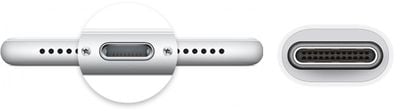
However, the wording of the MoU offered Apple a loophole: For those phones that did not have a USB micro-B interface, an adapter was allowed under the agreed terms. And that's exactly what Apple did. In 2012, Apple introduced the iPhone 5 with a new Lightning proprietary connector to replace its 30-pin connector, and additionally offered a separate Lightning to micro USB adapter to comply with the 2009 EU agreement.
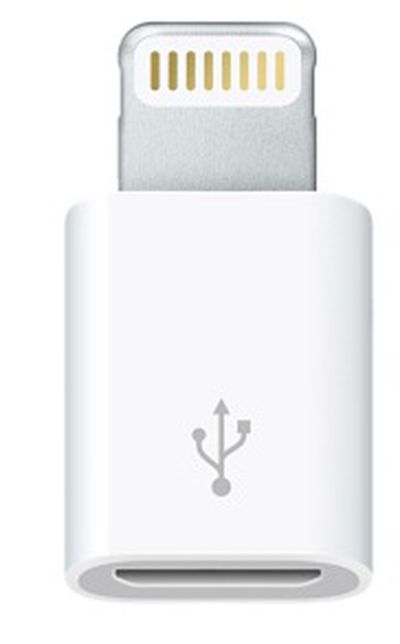
Consequently, Apple ultimately wasn't required to abandon its proprietary connector or include a separate micro-USB interface directly on the device for charging purposes.
Why Was the 2009 MoU Considered a Failure?
A progress report provided by the MoU signatories in February 2013 indicated that 90 percent of the new devices placed on the market by the signatories and other manufacturers by the end of 2012 supported the common charging capability. But that statistic was so high only because it took into account the fact that Apple offered a Lightning to micro-USB adapter.
One member of the Commission would note: "The perception among the citizens and the European Parliament is that the common charger does not really exist, and looking at what we find among the most popular smartphones, we have to agree with them. The future MoU must be clear in its outcome, we cannot afford to admit adaptors."
The lack of progress frustrated the Commission, and in 2014, the European parliament passed the Radio Equipment Directive, which called for a "renewed effort to develop a common charger." The directive gave the commission the power to directly set technical standards by means of a delegated act – in this case, a legislative act implementing EU rules.
By 2016, the Commission acknowledged that micro-USB had become dated and that USB-C had become the de facto standard across most devices. The Commission was advised by MoU facilitators that all manufacturers were ready to sign a new agreement in line with different approaches but keeping the solution of using solely USB-C connectors – except Apple.
Why is Apple Against the Idea of a Common Charger?
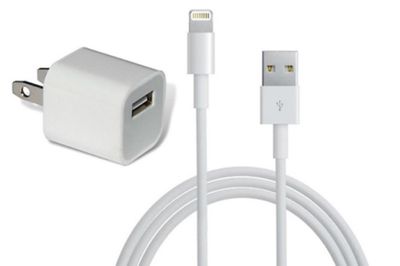
In 2016, Apple supported the adoption of USB-C as a standardized interface at the power source (i.e. the charging plug), but remained against conforming to a standard on devices themselves. The company argued that conforming to a device-side standard would cost it up to €2 billion and hamper innovation, largely based on the claim that iPhones were too thin to house a USB-C port.
Apple even commissioned a study by Copenhagen Economics outlining the potential consumer harm from a mandatory move towards a common charger.
The study concluded that it would cost consumers €1.5 billion if common charger rules became law, outweighing the €13 million associated with environmental benefits. The study also claimed that 49 percent of EU households rely on different types of chargers, but only 0.4 percent of those households experience any significant issues.
Apple's stance on the issue left the Commission deadlocked, but in 2018 the Commission agreed to continue working with manufacturers in order to achieve a suitable voluntary agreement. However, a year later the Commission concluded that its previous voluntary approach and the new MoU still allowed manufacturers to use adaptors with proprietary solutions and would not result in full charger harmonization.
Where Does the EU Go From Here?
In response to the Commission's 2019 impact assessment on common chargers, Apple said regulations that would force all smartphones to have the same charging port would "freeze innovation," be "bad for the environment," and be "unnecessarily disruptive for customers."
More than 1 billion Apple devices have shipped using a Lightning connector in addition to an entire ecosystem of accessory and device manufacturers who use Lightning to serve our collective customers. We want to ensure that any new legislation will not result in the shipment of any unnecessary cables or external adaptors with every device, or render obsolete the devices and accessories used by many millions of Europeans and hundreds of millions of Apple customers worldwide. This would result in an unprecedented volume of electronic waste and greatly inconvenience users. To be forced to disrupt this huge market of customers will have consequences far beyond the stated aims of the Commission.
The EU parliament's January 2020 vote on the matter was overwhelmingly in favor of bringing in rules to standardize chargers, but the manner in which it plans to enforce them is anything but clear. The Commission's impact assessment laid out several possible options for the proposed legislation:
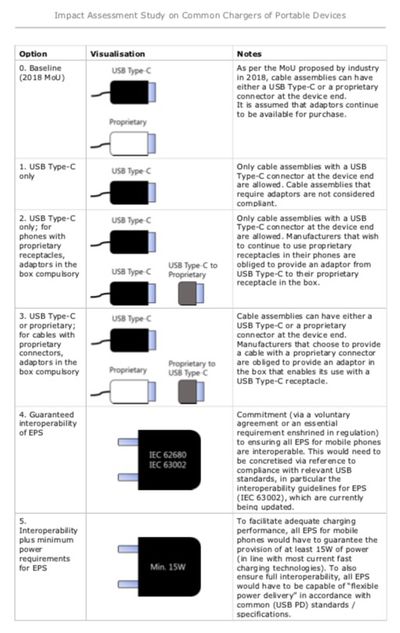
- Option 0: Cables can have either a USB-C or a proprietary connector at the device end, and adapters continue to be available for purchase (the current status quo).
- Option 1: Cables must have a USB-C port at the device end (effectively outlawing Apple's Lightning connector).
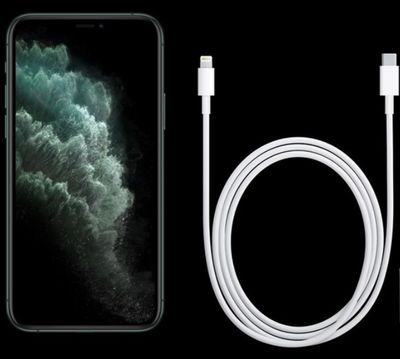
- Option 2: Cables must have a USB-C port at the device end, or any manufacturers that wish to use a proprietary port on their device must include an adapter from USB-C to the proprietary connector (in Apple's case, a USB-C to Lightning adapter) plus a USB-C AC power plug.
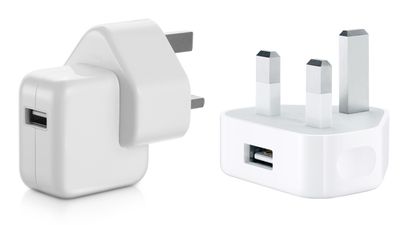
- Option 3: Cables can have either a USB-C or a proprietary connector at the device end. Manufacturers that choose to use a proprietary connector must include a USB-C AC power plug in the box (Apple provides a USB-C AC power plug, but the iPhone can continue to have a Lightning connector).
- Option 4: All connectors at both the device-end and on the AC power plug must have USB-C interoperability (Apple must make USB-C chargers).
- Option 5: All connectors at the device-end must be USB-C and manufacturers must include a new fast-charging 15W+ AC power plug (Apple must make a USB-PD-compliant power plug).
In considering wireless charging as a potential solution, the Commission concluded that it was an "incipient technology" with around 60 percent energy efficiency, whereas wired technologies are close to 100 percent efficiency.

Overall, the Commission's impact assessment suggests the most effective approach would be to pursue option 1 (common connectors) in combination with option 4 (interoperable external power supply). If the Commission were to go with this recommendation, Apple would no longer be able to make new mobile devices that use its proprietary Lightning connector. But whether the Commission accepts the recommendation of its impact assessment and enshrines it in EU law remains to be seen.
Can the Initiative Work?
The EU initiative aims to limit fragmentation of the charging solutions on the market without hampering future technological innovation. By standardizing chargers, it hopes to lower prices and increase quality, therefore reducing the presence of counterfeit chargers and increasing user safety.
It also expects a reduction/minimization of e-waste, by reducing the necessity to purchase different types of chargers and by giving the possibility to reuse already owned ones. This would also increase consumer convenience, argues the impact assessment, since users would be able to charge not only mobile phones "but potentially also other portable devices with a common cable (and charger), as well as being offered the option of retaining existing chargers and purchasing mobile phones without chargers for a lower price."
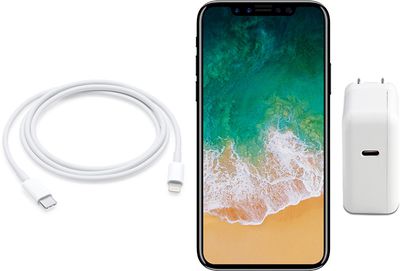
It is unknown whether any changes Apple might have to make to comply with the European regulations will also be made in other markets around the world, for financial or practical reasons. Regardless, however the proposed legislation plays out, all the signs are that Apple's stance will remain firm and it will continue to lobby against the EU's intention to regulate the market.
"We do not believe there is a case for regulation given the industry is already moving to the use of USB Type-C through a connector or cable assembly," said Apple following the recent parliamentary vote. "This includes Apple's USB-C power adapter which is compatible with all iPhone and iPad devices. This approach is more affordable and convenient for consumers, enables charging for a wide range of portable electronic products, encourages people to re-use their charger and allows for innovation."