

Earlier this month, Apple purchased its first company that develops health-related hardware, Beddit. Beddit makes an iPhone-connected Sleep Monitor that tracks a wide range of sleep-related metrics, from heart rate and sleep time to room temperature and respiration.
When Apple acquires a company, the company in question typically shuts down and stops selling whatever product it makes as Apple assimilates the technology into its own offerings, but that's not the case with Beddit. Apple is still selling the Beddit Sleep Monitor in its stores, and the Beddit privacy policy has been updated to note that Apple is collecting Beddit sleep data.
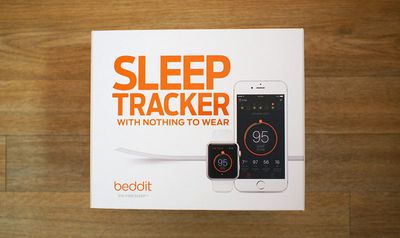
That raises some interesting questions about Apple's future plans. Will that sleep tracking data contribute to an upcoming Apple Watch with sleep tracking functionality? Does Apple have plans for some other kind of sleep tracking device? Will Beddit be one of several health-related companies Apple purchases so it can sell a range of hardware products?
Apple's plans for the Beddit technology may be a mystery right now, but we can take a closer look at the Sleep Monitor to see just what it can do, what kind of data Apple is gathering, and whether it's worth buying. I bought a Beddit Sleep Monitor shortly after Apple announced its acquisition, and I've been testing it for the past 10 days.
The Beddit Sleep Monitor belongs to a class of sleep tracking devices that aren't wearable. It's meant to be placed directly on the bed under the sheets rather than on the body. Design wise, it consists of a long strip of fabric that's about 2.5 feet in length and three inches wide. One side is a soft, pliable material, while the other side, which sits on the mattress, is backed with rubber so it stays in place. It's small enough that it's easy to pack up when traveling.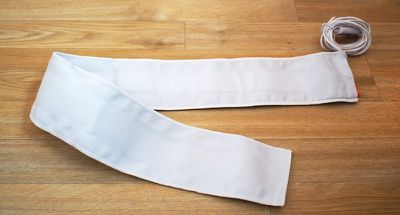
The Sleep Monitor is meant to be placed underneath the bottom sheet of a bed, on top of the mattress near where the heart is located when you lie down. It can be placed on one side of the bed in a shared bed, or in the middle for a person who sleeps alone. While it can be used in a shared bed, Beddit is meant for one person, and because the sensor is directly underneath the body, it accurately picks up the movement of a single person even when two people are in the bed.
In my testing, the Sleep Monitor never picked up movement or measurements that weren't mine, and it never failed to monitor me. I installed it on my side of a full-sized bed, right at the level where my heart is. Beddit says the Sleep Monitor is unnoticeable during sleep, and while it is indeed made from a thin, flexible fabric, I can feel it under my sheet. It isn't exactly bothersome and doesn't prevent me from sleeping, but I know it's there.
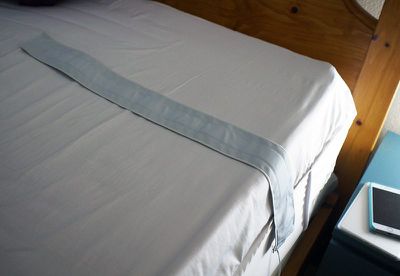
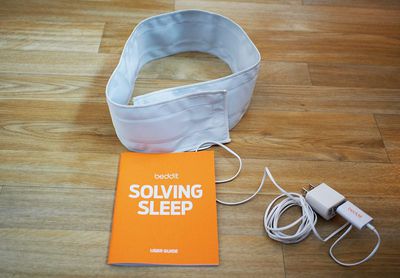
It's not supposed to move because of the rubber backing, but it does shift around. I don't move much in my sleep so the movement wasn't an issue for me, but someone who tosses and turns might need to make regular adjustments to its position. It's also worth noting that the Beddit has a thin, unobtrusive cord that needs to be plugged in at all times, so it will need to be near an outlet.
So what does the Beddit track? As it turns out, a lot. It goes beyond wearable sleep trackers that rely solely on movement to determine sleep quality, and some of what it tracks is potentially very valuable for people with breathing-related sleep issues. Here's everything it keeps tabs on:
- Sleep time
- The time it took to fall asleep
- Light sleep vs. deep sleep (no REM measurement)
- Number of times out of bed
- Restless sleep (lots of tossing and turning)
- Sleep efficiency (based on time spent asleep)
- Sleep score (an overall score that takes everything into account)
- Snoring (via iPhone speaker)
- Heart rate
- Respiration (breaths per minute)
- Average room temperature
- Average room humidity
With so many aspects of the sleeping experience being tracked, the Beddit Sleep Monitor gives a comprehensive overview of everything that happens while you're asleep. Having a complete overview makes it easier to recognize patterns and problems that are interfering with sleep, especially when it's easy to see right in the accompanying Beddit app.
So is it accurate? For the most part, yes. My heart rate measurements were in line with what I see with my Apple Watch, and the respiration measurement and temperature were spot on too. Sleep time, sleep efficiency, and the time it took to fall asleep were areas where felt like I had less of a clear picture, though.
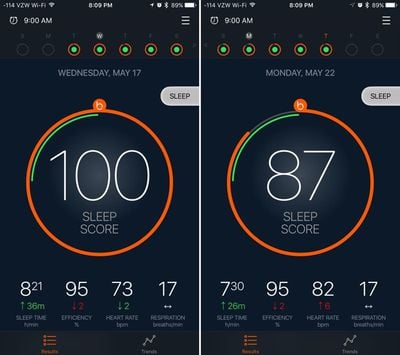
I'm a light sleeper and it often takes me a long time to fall asleep, but at the same time, I don't move a lot. Beddit could not tell the difference between when I was awake lying in bed and when I was actually asleep, whether it was when I was falling asleep for the first time or when I woke up in the middle of the night.
That's led to some overestimation of the amount of time I'm asleep, which in turn impacts the sleep efficiency score. It's not wildly inaccurate every day, but it's been off by as much as a half hour. Someone who lies awake (and still) in bed for long swaths of time may be disappointed with the accuracy of the Beddit. A more restless sleeper won't have this problem because the Sleep Monitor will pick up the movement.
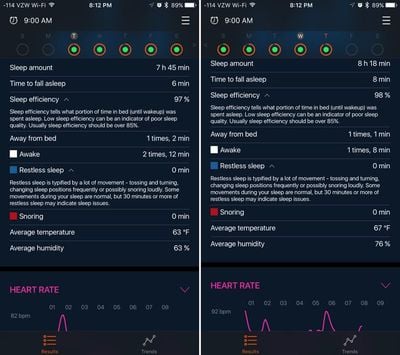
Though the sleep efficiency/time measurement is not entirely accurate for me, the sleep graph in the app gives me a much clearer picture of how my night went. It measures light sleep and deep sleep, and while the app tells me I was asleep when it dips down sharply, that's actually when I was awake. The Beddit Sleep Monitor seems to be accurately interpreting my sleep/wake patterns, but then misreading some of the data when calculating sleep efficiency and sleep score.
When I want a general idea of how I slept in a given night, I check the graph before relying on the sleep time and sleep efficiency numbers. The graph, though, is only divided by hour and so the information I have is limited - this would be a lot more useful if I could drill down into more specific timeframes. As an example, it'll tell me I got out of bed sometime near 3:00 a.m., but it won't give me the exact time.
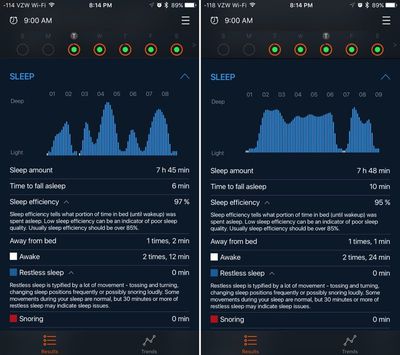
Along with the light/deep sleep graph, the Beddit app offers up concrete numbers on all of the different tracking metrics, plus a graph for heart rate. Comparing the sleep graph and the heart rate graph has proven to be interesting because of the correlation between the two. There are often small jumps in my heart rate at the times when Beddit says I'm most deeply asleep, which seems to relate to dreams/nightmares.
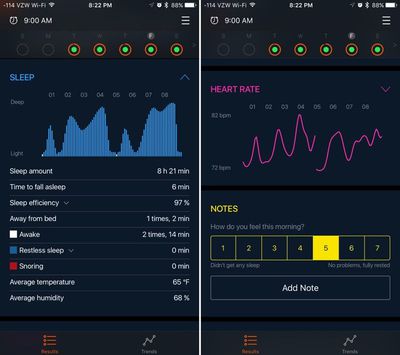
The Beddit app measures two factors I wasn't able to properly test -- snoring and restless sleep. I don't seem to move enough to trigger any restless sleep readings, and I don't snore. My partner snores, though, so I can say that it's sensitive enough to tell my breathing from his. By the way, the Beddit has been able to track my sleeping accurately regardless of position. I'm a side or stomach sleeper, but also tested sleeping on my back. There's no difference in the data.
Beddit data is displayed on a day-by-day basis, but there are also options to see trends over 7, 30, and 90 days. Trends cover sleep score, sleep time, heart rate, bedroom temperature/humidity, and a notes feature, which is actually one of the handiest ways to measure sleep trends.
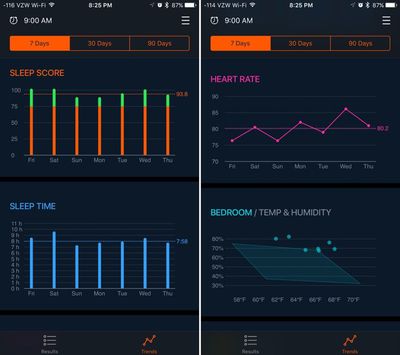
Each morning, you can rate how you feel after a night's sleep and add notes and tags to keep track of factors that might have impacted sleep. My cat meows some mornings, so I might add a note that I was woken up by the cat. If I ate something unusual or drank caffeine late in the day, those are also things that could be noted, and over time, I might be able to notice trends. Tags are important because the app will automatically correlate tags with sleep efficiency scores.
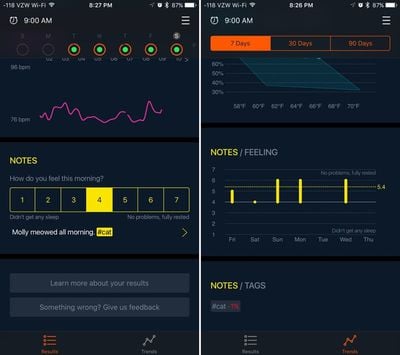
There's a built-in smart alarm feature in the Beddit app, designed to go off up to 30 minutes before the set time whenever sleep is lightest. The idea is that if you're woken up in a light sleep, you'll be less groggy. It worked semi-well, but 30 minutes is a long window and there's no customization option to shorten it.
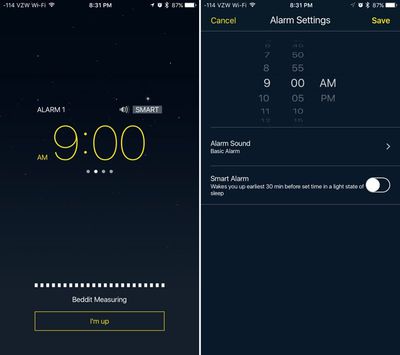
One other thing worth noting -- Beddit can be set to automatically start tracking sleep as soon as you get in the bed at night, so there's no need to open the app and turn it on. I liked the convenience of this feature, but ended up leaving manual activation on because I like to read in bed before sleeping and the Beddit thought I was asleep when I was reading.
Overall, the Beddit app is well done and it offers up a lot of info, but there are some negatives. First of all, the Beddit Sleep Monitor needs to be continually connected to the iPhone via Bluetooth when it's in use at night, which Beddit says is necessary because of the amount of data being transferred. With a continual Bluetooth connection, the Beddit is a serious battery drain (it'll suck up a good 30 to 40% on an iPhone 7 Plus). You're going to want to plug your iPhone in at night when using it.
Second, snoring tracking is done on the iPhone, and there's no way to disable it. That means Beddit is using the microphone, which happens to disable my AirPods and other Bluetooth headphones. It also prevents "Hey Siri" hands-free commands from working. There is no option to disable snoring tracking, which is a downside for people who don't snore.
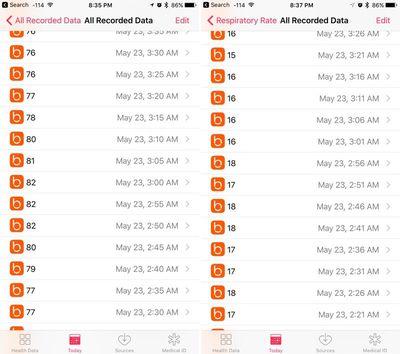
Third, given the amount of information the Sleep Monitor tracks, I think the app could offer up more detail, like a clearer picture of specific heart rate and respiration rates over time. Luckily, it connects to Apple Health, and all of this data is synced there.
In the Health app, you can see each respiration and heart rate measurement during the night, and the Beddit also syncs overall sleep data.
One last thing -- the Beddit is compatible with nap taking. It tracks nap length just like a standard night of sleep and adds that information to the day's overall sleep score and sleep time.
Bottom Line
In 10 days, the Beddit Sleep Monitor hasn't taught me anything I didn't already know, but as someone who likes to track things and collect data, I find the information it's giving me valuable, even if some of its conclusions about my sleep aren't 100 percent accurate. I suspect that with longer use and more attention to tags, I might be able to learn more.
I've had sleep problems my entire life, so I've already learned to stick to a rigorous sleep routine, but someone who needs help establishing good sleep habits or figuring out what's impacting sleep could potentially benefit from the Beddit Sleep Monitor.
With its snoring, heart rate, and respiration features, Beddit will be able to pick up on sleep apnea and breathing issues, and the data combined with user notes can help suss out other sleep problems.
$150 is expensive, but if it's able to provide a better night's sleep for someone who's struggling, the high price tag is worth it. People without serious sleep issues who just like to keep track of health metrics will also likely be satisfied with the Beddit given the many things it tracks.
In its current incarnation, the Beddit Sleep Monitor is a decent sleep tracker. With Apple's tweaking, I think it could be a lot better. In my experience, it's collecting all the data it needs, but with some fine tuning, that data could be better interpreted and more valuable.
I've never used a sleep tracker that can tell the difference between when I'm lying in bed and when I'm asleep, but if anyone can solve that problem and refine sleep tracking algorithms, it'll probably be Apple. I'm interested to see what kind of improvements Apple can make to sleep tracking and what it plans to do with the data and the technology it has acquired from Beddit, so I'll keep using my Sleep Monitor.
How to Buy
The Beddit 3 Sleep Monitor can be purchased from Apple for $149.95.
















Top Rated Comments
Oh, good, I still have one! :rolleyes:
Also, hate to bring it up again but: on top of the mattress is under the bottom sheet, not the top sheet.
What concerns me is that up until recently they were offering a "family" web site (family.beddit.com) where you could log on and see a lot more of the data they are storing on their servers. Noticing it was redirecting to the main beddit.com site I contacted their support team who confirmed that the site had been taken down and that "There is no other method of excel export at present, and no future iterations of Beddit Family are planned".
I confess to being intensely uncomfortable about them taking such personal data, storing it yet providing users with no access to it whatsoever, other than via their locked down app.
I would be interested in knowing whether anyone shares these concerns?